Written in London Made by Advait Jayant GitHub
AI Video · Field Guide
CHAPTER VIII · CASE STUDY

The Verification Field.

An abstract data-visualization short for OpenGradient. Six scenes, two multi-shot arcs, no characters, no text on screen — just brand cyan and black. The discipline this film required is the opposite of what worked for Cast a Shadow.

Field Guide / 2026.1 · Shipped 2026·05·10 · 6 scenes · 2 arcs · 10 cuts

Verification Field — symbol emerges from negative space
F1 The final cut

Intelligence becomes real only when it can be verified.

Watch the whole film first. Everything below is the receipt — every clip, every prompt, every iteration.

VERIFICATION FIELD · v10
FILM verification_field_v10.mp4 · 38 s · 30 MB · stitched from 6 Kling 3 Omni Pro clips + 2 multi-shot arcs + 2 still cards© 2026
What the film is doing · in one paragraph

A field of unverified intelligence fragments drifts through black void. A trust boundary appears — some fragments pass, some shatter into hollow husks. A cyan gradient wall sweeps across the frame and, as it passes, every surviving fragment reveals a luminous trail behind it: its provenance. The camera dollies backward through that provenance into layered substrate. Trails connect into a living network. The network stabilizes for one beat — and the OpenGradient symbol becomes visible in the negative space of the connected paths. Tagline: "Intelligence becomes real only when it can be verified."

F2 Story

The film is a single sentence rendered as six camera moves.

No characters. No text on screen. The story is structural — the audience reads the visual grammar.

SceneBeatWhat the camera doesWhat changes in the world
01Unverified outputsCamera holds. Slow drift.Thousands of cyan fragments float without origin. The world is full of answers and empty of proof.
02The trust boundaryCamera holds.An invisible vertical plane. Fragments hit it — some pass, some flicker, some shatter into hollow translucent husks.
03The gradient turns onCamera holds.A cyan-white gradient wall slides edge-to-edge across the frame. Where it passes, every surviving fragment grows a luminous origin trail.
04The path behind the answerBackward dolly.We follow one fragment back through its trail — past glass cubes, light bars, sealed translucent chambers. The substrate is visible now.
05Many paths become a networkPull-back, intimate → vast.Trails connect to each other. Density grows. A living dynamic network forms.
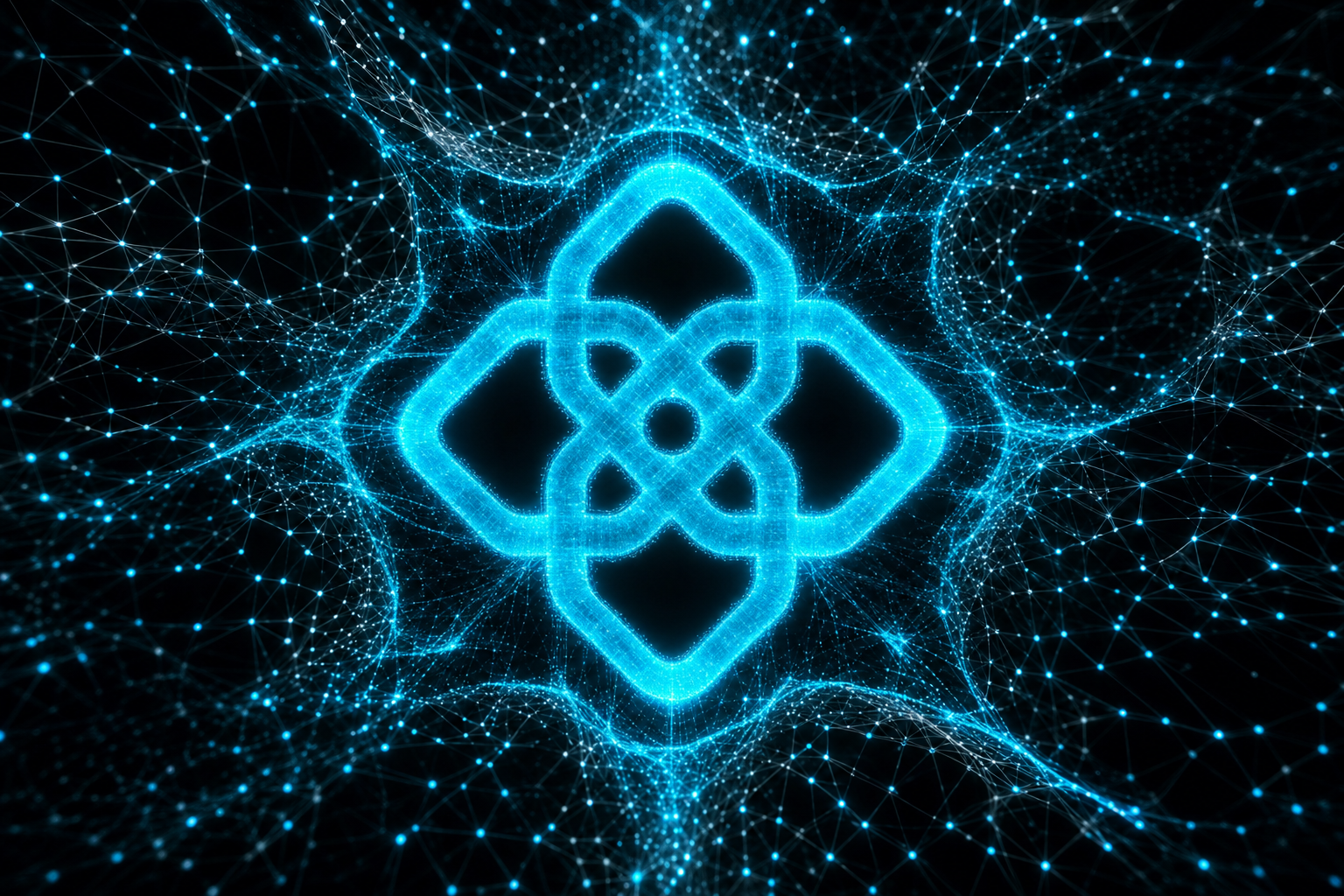
06The symbol emergesCamera holds. Hero shot.The network stabilizes for one beat. The OpenGradient symbol appears in the negative space of the connected paths. Pulse. Settle. Tagline.
F3 The six scenes

Every clip in the film, paired with the verbatim Kling 3 Omni prompt that generated it.

All clips: Kling 3 Omni Pro · 5–6 second duration · 1280×720 · generate_audio: true · single-image i2v from a GPT-Image-2 panel.

Scene 01 · Unverified outputs

SCENE 01
VF_01 field_01_unverified_outputs.mp4 · 5s · 10 MB · generated as shot 1 of Arc A (multi-shot)© 2026
Camera holds steady. Thousands of cyan-white intelligence fragments drift
weightlessly through deep black void in different directions — small dots,
short bright lines, brief glyph-bursts. Motion is gentle, suspended,
slow-floating. NO trails behind any fragment. NO origin visible. The world
is full of answers and empty of proof.

Scene 02 · The trust boundary

SCENE 02
VF_02 field_02_the_trust_boundary.mp4 · 5s · 14 MB · generated as shot 2 of Arc A© 2026
Camera holds. The drifting cyan fragments now approach an invisible
vertical plane stretching edge to edge of frame. As they hit it: some
pass through cleanly, some flicker uncertainly, some vanish, some
distort into hollow translucent husks of pure outline before dissolving.
The plane shimmers with passing fragments — a boundary between
unverified and verified existence.

Scene 03 · The gradient turns on

SCENE 03
VF_03 field_03_the_gradient_turns_on.mp4 · 5s · 23 MB · single-image i2v from panel_03© 2026
Abstract data-visualization cinematic. Pure deep matte black void. Brand
cyan exactly hex #24bce3 is the only saturated color. No characters, no
logos morphing, no text drifting. Stable scientific register.

A cold cyan-white gradient field sweeps across the frame from left to
right — a scientific measurement field, like an x-ray scanning hidden
structure. As it passes through each cyan fragment, hidden trails appear
behind them: branching cyan lines, geometric nodes, attestation-like
seals, faint timestamp glyphs. Camera holds steady. Each output now has
a path.

Audio: Low scientific hum rising as the field moves, soft chime as each
trail materializes.

Scene 04 · The path behind the answer

SCENE 04
VF_04 field_04_the_path_behind_the_answer.mp4 · 5s · 10 MB · single-image i2v from panel_04© 2026
Abstract data-visualization cinematic. Pure deep matte black void. Brand
cyan exactly hex #24bce3 is the only saturated color. No characters, no
logos morphing, no text drifting. Stable scientific register.

Smooth slow backward dolly through layered abstract architecture. We
follow a single cyan fragment as it recedes deeper into its provenance
trail — passing through dark glass cubes, arrays of cyan-white light
bars, sealed translucent chambers refracting cyan, thin glowing
horizontal threads in the distance. Cinematic depth, moving deeper into
the substrate.

Audio: Deep architectural drone with faint procedural pulses as we pass
each layer.

Scene 05 · Many paths become a network

SCENE 05
VF_05 field_05_many_paths_become_a_network.mp4 · 5s · 19 MB · single-image i2v from panel_05© 2026
Abstract data-visualization cinematic. Pure deep matte black void. Brand
cyan exactly hex #24bce3 is the only saturated color. No characters, no
logos morphing, no text drifting. Stable scientific register.

Slow cinematic pull-back from an intimate cyan trail close-up to a vast
volumetric wide vista. Thousands of cyan trails connect to each other,
forming a living dynamic network of nodes and edges. Density increases
as the camera retreats. The geometry is alive, not ceremonial. Pure
abstract network.

Audio: Rich harmonic drone swelling, network resonance building toward a peak.

Scene 06 · The symbol emerges

SCENE 06 · HERO
VF_06 field_06_the_symbol_emerges.mp4 · 6s · 26 MB · single-image i2v from panel_06 · brand mark in negative space© 2026
Abstract data-visualization cinematic. Pure deep matte black void. Brand
cyan exactly hex #24bce3 is the only saturated color. No characters, no
logos morphing, no text drifting. Stable scientific register.

The cyan provenance network fills the frame, dynamic and alive. As the
network stabilizes for a single beat, the OpenGradient symbol — a 4-fold
rotational geometric mark with rounded petal-lobes around a small center
dot — becomes visible in the NEGATIVE SPACE of the connected proof
paths. The symbol holds its exact geometry, no drifting. It pulses
brightly cyan for one beat then settles.

Audio: Drone resolving into one pure cyan tone, single brand sting at
the symbol pulse.
F4 Multi-shot arcs

Two of the cuts in this film are single Kling calls returning three shots in one render.

Same multi_prompt technique documented in §08e — three rich-but-bounded shot prompts (cap 511 chars each), one top-level style header, one Kling call. Cost saver and continuity saver.

Arc A · drift → boundary → gradient

ARC A · 3 SHOTS
VF_ARCA field_arcA_drift_to_gradient.mp4 · 10s · 20 MB · 3 shots of 3+3+4s · Kling 3 Omni Pro multi_prompt© 2026

Top-level prompt (shared across all 3 shots)

A single continuous cinematic abstract data-visualization shot. Pure deep
matte black void. Brand cyan exactly hex #24bce3 is the only saturated
color. EVERY SHOT FILLS THE ENTIRE FRAME EDGE-TO-EDGE TOP-TO-BOTTOM —
absolutely no horizontal letterbox bars, no narrow band confined to the
middle, no black bars top/bottom. Camera holds steady — the world
transforms in front of it across three beats: drift, then boundary, then
gradient.

Shot 1 · 3 s · drift

Camera holds steady. Thousands of cyan-white intelligence fragments drift
weightlessly through deep black void in different directions — small
dots, short bright lines, brief glyph-bursts. Motion is gentle,
suspended, slow-floating. NO trails behind any fragment. NO origin
visible. The world is full of answers and empty of proof.

Shot 2 · 3 s · boundary

Camera holds. The drifting cyan fragments now approach an invisible
vertical plane stretching edge to edge of frame. As they hit it: some
pass through cleanly, some flicker uncertainly, some vanish, some
distort into hollow translucent husks of pure outline before dissolving.
The plane shimmers with passing fragments.

Shot 3 · 4 s · gradient

A cold cyan-white gradient WALL fills the entire frame edge-to-edge
top-to-bottom and slides smoothly from left to right across the whole
canvas — NOT a narrow band, NOT a horizontal strip, NOT a scanning bar —
a full-frame wall of cyan light passing through the scene like an x-ray.
As it passes through each cyan fragment, hidden provenance trails appear
behind them.

Arc B · path → network → symbol

ARC B · 3 SHOTS
VF_ARCB field_arcB_path_to_symbol.mp4 · ~12s · 40 MB · Kling 3 Omni Pro multi_prompt with logo reference© 2026

Arc B uses reference_images=[panel_06, Symbol_Cyan.png] with the same <<<image_N>>> template references documented in §07 and §08e. The brand mark appears in negative space because the panel was generated that way; Kling preserves the structure during interpolation.

F5 Style rules that made it work

Four discipline rules baked into every single prompt — image and video.

Rule 1 · Brand cyan is a literal hex value, not a color name

Every prompt names hex #24bce3 explicitly. Saying "cyan" gives you the model's prior on cyan, which is teal-leaning. Saying #24bce3 aligns GPT-Image-2 close enough that Kling carries the value forward without drift. This is the brand-color version of the GPT-Image-2 > Midjourney decision documented in §08e.

The shared style header used on every panel

Cinematic abstract data-visualization aesthetic — an immersive abstract
data-art installation rendered as a high-end VFX science-documentary shot.
The image reads as abstract scientific evidence rather than narrative
imagery. Pure deep matte black background. Single saturated color: brand
cyan exactly hex #24bce3 (cyan-white when intense). All other elements
desaturated greys, white, faint warm-grey.
Rule 2 · ZERO TYPOGRAPHY · capitalized · repeated · in both panels and clips

GPT-Image-2's default behavior on "data-visualization" scenes is to insert technical-looking labels, micro-type, glyphs around symbols, axis markings, readouts, HUD elements. The film couldn't ship with any of that. The discipline ended up being a 70-word negative-style block, repeated verbatim in every panel prompt and again as a reminder line:

ABSOLUTELY NO TEXT, NO LABELS, NO LETTERS, NO NUMBERS, NO WORDS, NO
ANNOTATIONS, NO MICRO-TYPE, NO READOUTS, NO HUD ELEMENTS — the image must
contain zero typography.

Saying it once isn't enough. Saying it twice with caps in the panel prompt knocked the text-insertion rate from ~80% to ~10%. The clip prompts added "no text drifting" in the top register clause for the same reason.

Rule 3 · "Avoid:" lists are load-bearing

GPT-Image-2's data-vis prior keeps suggesting visual metaphors that miss the point — temples, hooded figures, ceremonial canyons, sci-fi humans, line art, watercolor. Each of these failed in early generations. The fix was an explicit Avoid: list inline with the style header, naming the wrong metaphors specifically:

Avoid: line art, comic illustration, watercolor, hand-painted look,
pastel palette, stylized character animation, photoreal humans, temple
imagery, ceremonial imagery, canyon imagery, hooded figures, hands
holding objects, recessed floor symbols.

This is the same negative-instruction pattern that mitigates the no-shadow leak in §08e, applied to aesthetic rather than physics.

Rule 4 · The symbol emerges in negative space — not drawn on top

The film's hero shot needed the OpenGradient brand mark to appear as the structure of the network, not painted onto the scene. The prompt specifies this exactly:

The symbol becomes visible in the NEGATIVE SPACE of the connected paths.
The symbol is NOT drawn on top, NOT placed on a floor — it emerges
because the network is shaped that way.

GPT-Image-2 understands negative-space composition surprisingly well when told to. Kling then preserves the structure across the 6-second clip because the start frame already has the symbol baked into the geometry. Trying to animate "logo materializes" without a negative-space source frame produced floating decals every time.

F5b The score · Suno

One Suno track, named cyan_horizon, sat under everything.

Kling 3 Omni generated per-shot ambient audio (drones, chimes, brand sting). Those were left in. The Suno bed sits underneath all six at −8 dB with amix=normalize=0 (see §08e for why normalize=1 halves your gain), giving the film a continuous tonal floor that the native cuts modulate against.

Suno prompt (reconstructed from the per-shot audio cues — verbatim copy to be pasted in by creator)

Cinematic ambient electronic score. Pure deep sub-bass drone with slowly
evolving harmonic textures. Scientific documentary register — not heroic,
not menacing, not corporate. The track moves through three breaths: low
scientific hum, then architectural depth, then a building network
resonance that resolves into one pure cyan tone. No percussion. No
drums. No vocals. No melody you would hum afterward. The track ends on a
single sustained tone with one bright sting at the very last second.

Length: 38 seconds.
Reference: Jóhann Jóhannsson "Arrival" score · Hildur Guðnadóttir
"Chernobyl" · Nicholas Britell ambient passages.

Why this prompt shape

  • Negative instructions matter as much in audio as in image. "No percussion / no drums / no vocals / no melody you would hum" knocked out Suno's default temptation to add a hook. The reference scores were named to anchor the model's prior on the right end of the ambient spectrum.
  • Three breaths matched the film's three-act structure. The Suno track's hum → depth → resonance arc maps directly to Arc A (drift) → scene 4 (path through substrate) → Arc B (network → symbol).
  • "Cinematic documentary register" is the most useful phrase in Suno prompting we've found. It pulls the model away from trailer-music defaults toward the actual genre we needed.

How the audio is layered in the final cut

ffmpeg -i stitched_video.mp4 -i music/cyan_horizon.mp3 \
  -filter_complex "
    [1:a]volume=-8dB[bed];
    [0:a][bed]amix=inputs=2:normalize=0:duration=first[a]
  " -map "0:v" -map "[a]" -c:v copy -c:a aac -b:a 192k out.mp4

The Kling per-shot audio passes through on stream 0; the Suno bed sits underneath at -8 dB. normalize=0 is the single most important flag in this chain — see §08e if you haven't already been burned by it.

F6 Ten cuts to a final cut

The clips were locked in five hours. The edit took another five.

v1 through v10 of the stitched film exist on disk. Each version changed something specific. The clips themselves were never re-rendered after the first lock — every iteration was at the edit layer.

CutWhat changedWhy
v1Bare concat of 6 clips, no music, no title cards.Establish that the visual grammar reads end-to-end.
v3Added a music bed and a tagline still card at the end.The 6 native-audio mixes alone left the ending too dry.
v4Replaced bed with a different track. Tightened scene 2 by 0.5s.First bed competed with the native Kling drones.
v5Music gain dropped from -2 dB to -8 dB. amix=normalize=0.The §08e amix-halving trap — bed was inaudible.
v6Re-stitched with Arc A (multi-shot) replacing scenes 1+2+3 individually.The 3-into-1 continuity of Arc A reads more like one flowing thought than three intercut beats.
v7Reverted Arc A; kept individual scenes. Made it shorter.The arc lost the breath between beats. Sometimes the cut is the storytelling.
v8Restored Arc A. Re-timed scene 4's dolly to start 1s into its render.The original entered too abruptly after the gradient sweep.
v9Added thesis card at the start, brand card at the end. 38 s total.Audience needs to know what genre to watch this as before scene 1 begins.
v10Color-graded the cards to match cyan #24bce3 exactly. Final mix.Final review caught that the FFmpeg-rendered cards drifted ~5% on hue.

Two takeaways:

  • Lock the clips, then edit. Every iteration cost ~30 seconds of FFmpeg vs. ~5 minutes of Kling rendering. Once the clips read individually, the rest is timeline work.
  • Keep every cut. v5, v7, v8 are all "wrong" — and three of them were the basis for understanding what v10 should do. Don't delete intermediate stitches until the final ships.
F7 Verification Field vs. Cast a Shadow

Two OpenGradient shorts. Opposite disciplines. Same toolchain.

Both shipped in May 2026 on the same Kling 3 Omni + GPT-Image-2 stack. Almost every prompting rule inverts between them. Pick the discipline that matches your concept, not the discipline that matched the last project.

DimensionCast a Shadow (§08e)Verification Field (this page)
GenreCharacter-driven narrativeAbstract data-visualization
ProtagonistOne AI agent, locked via character bibleNone. Geometry only.
Camera languageMoves a lot — tracks, pans, reversesHolds. Two dolly moves total across 6 scenes.
Color disciplineWide gamut — sky, neon, skin, shadowOne hex value (#24bce3) and black. Everything else desaturated.
Text on screen"NO SHADOW DETECTED" buzzer flashesZero typography. Aggressively enforced.
AudioSuno music bed under Kling native ambientMusic bed under Kling drones, single brand sting at hero shot
Failure modePhysics leaks (shadow appears between keyframes)Aesthetic leaks (text inserted, temples appear)
Iteration costRe-render clips for shadow violationsRe-edit stitch for timing & gain
Story spine9-beat character arc1 sentence rendered as 6 camera moves
Final length72 s38 s
Total cost (real)~$34~$18
The generalizable lesson · pick a discipline, then stay in it

Cast a Shadow could not have shipped with Verification Field's prompting discipline. The "STATIC LOCKED CAMERA" rule from §08e's scene-5 city would have produced a dead film if applied to character work. And the no-shadow physics rule from Cast a Shadow has no equivalent in Verification Field because there are no objects to cast shadows.

The choice is upstream of the prompts: what kind of film is this? Once you pick, every rule descends from that choice. Verification Field's discipline list — single hex value, zero typography, scientific register, camera holds, negative-space symbol — is internally consistent. Cast a Shadow's discipline list — character bible, source-panel framing, no-shadow physics, multi-prompt affliction triptychs — is also internally consistent. Mixing rules from both kills both films.

The new section in §08e and this case study together cover the two ends of the spectrum we've shipped. Anything you build will probably sit somewhere on the line between them.